U.S. Army Turns Merops Interceptor Drone Into Formal Program In 142 Days
The U.S. Army moved the Merops counter-drone interceptor from an urgent request to a formal program in 142 days, faster than its 180-day target, according to a senior acquisition official speaking at the AUSA convention.
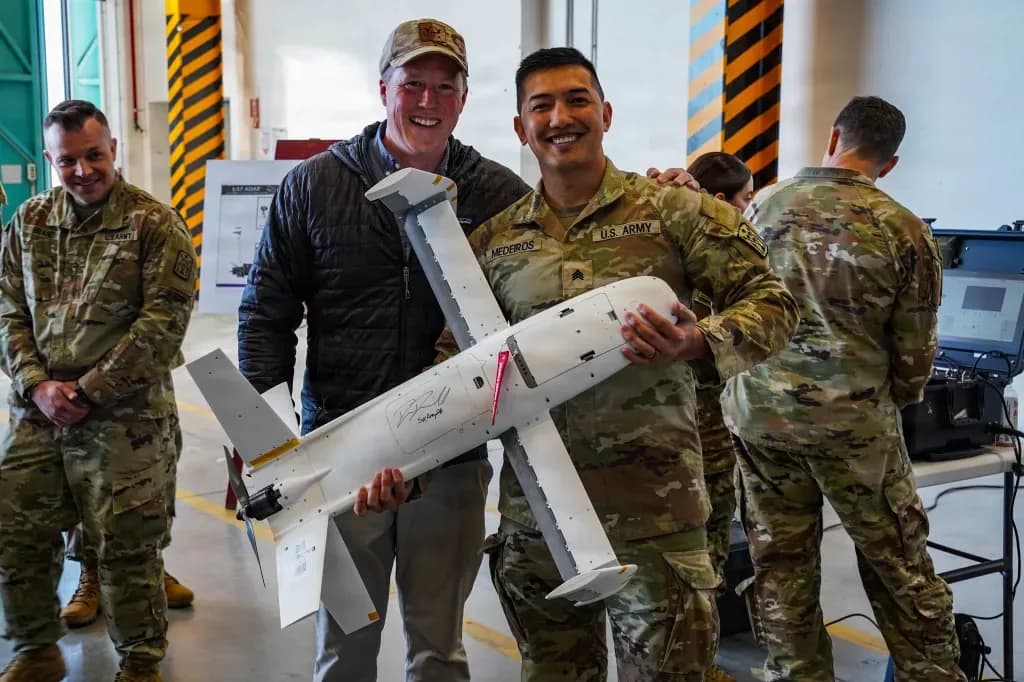
The U.S. Army converted the Merops interceptor UAV into a formal program in 142 days, an acquisition milestone that shows how the service wants to field proven capabilities to troops and allies faster. Col. Christopher Hill, director of the Army's Global Tactical Edge Acquisition Directorate (G-TEAD), spoke about the effort at the Association of the U.S. Army's main annual convention in Washington, D.C., The War Zone reported. He presented it as proof that the service can act quickly when needed.
The Merops is a small, relatively low-cost counter-UAS system built to destroy long-range one-way attack UAVs in flight. It was first developed under the U.S.-backed Project Eagle initiative, with contributions from Swift Beat, a company associated with former Google CEO Eric Schmidt. The system uses Surveyor drones as airborne interceptors. They carry onboard sensors to track targets and can fly autonomously or under remote control. An interceptor can bring down a hostile unmanned aircraft by hitting it directly or by detonating a proximity-fused explosive warhead.
The Army first looked at the system after drone incursions involving two NATO partners led a senior commander to call for an urgent response. According to Hill, the commander wanted the capability in the partners' hands within 14 days. Merops had not been part of the commander's initial acquisition plan, but its performance in Ukraine made it a strong candidate.
The Army missed the 14-day goal. Hill said acquisition personnel and soldiers deployed to the theater to evaluate the system, and NATO partners had it in roughly 21 or 22 days.
In that region, U.S. forces have faced Iranian Shahed-136 and other one-way attack drones, which have been launched in barrages against American and allied forces and installations. Army Secretary Daniel Driscoll has pointed to Merops as an attractive answer to these threats because of its low price and quick acquisition.
In congressional testimony, Driscoll said the Army bought 13,000 Merops interceptors about eight days after the conflict with Iran began. He put the price at roughly $15,000 per interceptor, a figure that could drop below $10,000 as production scales up. In a separate Bloomberg interview, he suggested that larger orders might eventually bring the price to between $3,000 and $5,000.
Shahed drones are estimated to cost tens of thousands of dollars each, while conventional air defense interceptors cost far more. Using cheaper drones against them can improve the cost balance and save more advanced interceptors for threats that need them.
Ukraine has used Merops together with domestically built interceptor drones against Russian Shahed/Geran one-way attack drones. That combat use has helped show the promise of a newer class of air defense weapons that do not depend only on expensive surface-to-air missiles.
Hill warned, however, that success in Ukraine does not guarantee equal performance everywhere. He acknowledged that Merops was shaped by Ukraine, where the Army saw the capability, but said how the system is employed matters a great deal. He noted that effectiveness will differ by environment, for example between deserts and the urban areas where the system has operated in Ukraine.